Lost Your Android Phone? Use Find Hub to Find, Lock, or Erase It
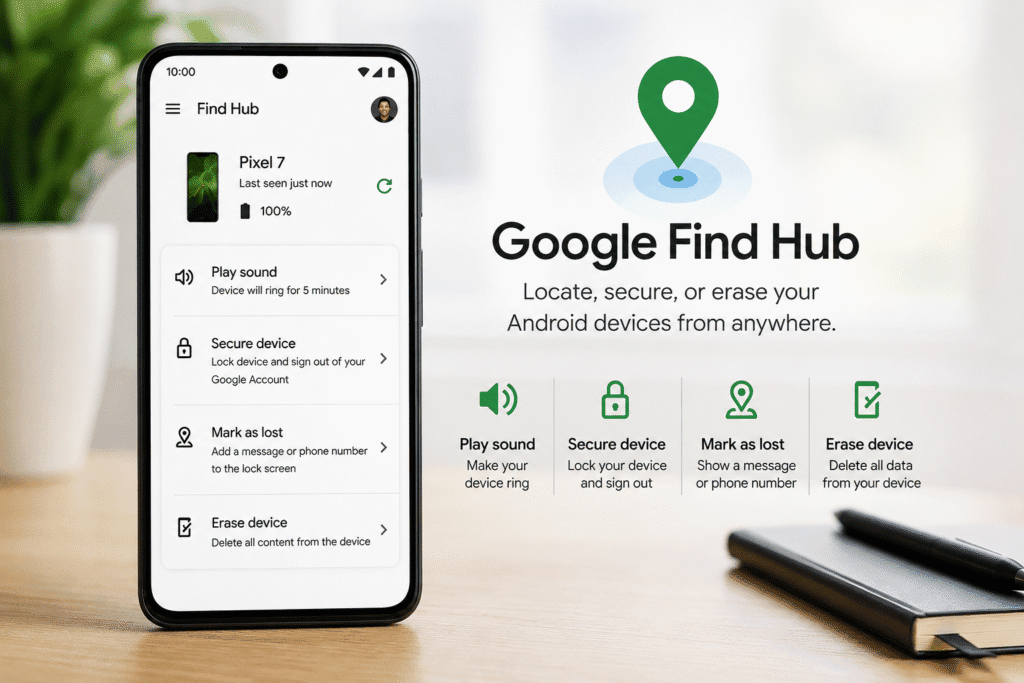
Losing your Android phone can be stressful, but Google’s Find Hub gives you several ways to locate it, secure it, or erase it if recovery looks unlikely. If you remember the older name Find My Device, Find Hub is the newer version of Google’s device-finding service. It can help you: Here’s what to do if your Android phone goes missing. 1. Open Google Find Hub Use another phone, tablet, or computer and open Google Find Hub. Sign in with the same Google Account that is used on your missing Android phone. If you are using someone else’s Android phone, you can use the guest sign-in option instead of permanently adding your Google Account to their device. After signing in, select your missing phone. Find Hub will try to show the phone’s location on a map. If it cannot find the phone’s current location, it may show the most recently available location instead. 2. If the Phone Is Nearby, Make It Ring If the map suggests your phone is somewhere nearby, use Play sound first. Find Hub can make the phone ring at full volume for up to five minutes, even when the phone is set to silent or vibrate. This is useful if your phone is: Using Play sound is usually faster than repeatedly calling your own number. 3. Check the Location Carefully Look at the location shown on the map, but remember that the pin may not show the phone’s exact physical position. Android can estimate location using information such as: Location accuracy may be lower indoors, underground, or in places with weak signals. Also check when the location was last updated. A location from a few hours ago should not be treated as a live location. If the phone appears to be at a restaurant, office, store, or other place you recently visited, calling that location may be the fastest option. 4. Use Find Nearby When Available Some supported devices and accessories may provide a Find nearby option when you are close to them. This can help you narrow down the location when a normal map pin is not precise enough. It can be especially useful inside: Availability depends on the device and hardware support. 5. Mark the Phone as Lost If you cannot recover your phone immediately, use Mark as lost. This locks the device using its existing screen-lock protection. You can also display a short message and a contact number on the lock screen. For example: This phone is lost. Please call me at [alternate phone number]. Use a number that you can currently answer. Do not put your: on the lock screen. 6. Can Find Hub Locate an Offline Phone? Sometimes. Find Hub can use encrypted recent location information and Google’s crowdsourced Find Hub network to help locate supported devices that are not currently connected to Wi-Fi or mobile data. Nearby participating Android devices may help provide location information. However, offline finding depends on several things, including: So an offline phone may still be locatable, but there is no guarantee. 7. What If the Phone Is Turned Off? If the phone has no power, it cannot continually send new location information. Find Hub may still show a recent location depending on the phone and its settings. Always check the time shown with the location. A location recorded several hours earlier may still help you retrace your steps. 8. Do Not Erase the Phone Too Quickly Find Hub also gives you the option to remotely erase the device. This should normally be your last resort. Erasing the phone permanently removes data stored on the device. More importantly, after the phone has been erased, its location will no longer be available through Find Hub. Consider erasing the phone when: If there is still a realistic chance of recovering the phone, try securing and locating it first. 9. What to Do If You Think the Phone Was Stolen Do not use the map location as a reason to confront someone. If your phone appears at an unfamiliar private location or seems to be moving unexpectedly, focus on protecting yourself and your accounts. You may want to: Remember that location estimates are not always exact. 10. Find Your Phone’s IMEI Your mobile carrier may ask for the phone’s IMEI number if the device is stolen. Find Hub may show device information that can help you locate the IMEI. It is also a good idea to save your IMEI somewhere safe before you ever lose the phone. 11. Android Remote Lock Supported Android devices may also offer Remote Lock. This feature can help you quickly lock a missing phone using your verified phone number. Remote Lock needs to be configured before you need it and may require: If the phone is offline when you send the request, the lock may take effect when the phone reconnects. 12. Turn On Android Theft Protection Newer Android versions may include additional theft-protection features. Availability depends on your phone model and Android version. Theft Detection Lock Theft Detection Lock can use device signals to detect movement that may indicate someone has grabbed the phone and run away. When Android detects possible theft, it can automatically lock the screen. Offline Device Lock A thief may try to disconnect the phone from the internet. Offline Device Lock can automatically lock the screen after the phone has been used offline for a period of time. Failed Authentication Lock Supported devices can automatically lock after repeated failed authentication attempts. Search your phone’s Settings for Theft protection to see which features are available on your device. 13. Set Up Find Hub Before You Lose Your Phone The best time to check Find Hub is while your phone is still with you. Check Your Google Account Make sure the correct Google Account is signed in on the phone. If you have several Google Accounts, remember which one is connected to the device. Make Sure Find Hub Is Enabled Open Android Settings and search for: Find Hub Make sure the