Urban logistics is on the brink of a profound shift as autonomous drones and delivery bots enter real streets, skies, and sidewalks. This article explores how these technologies will reshape last mile delivery, city design, commerce, and everyday life in dense urban environments.
In the coming decade, autonomous drones and delivery robots will move from experimental pilots to everyday urban infrastructure. Understanding how they will operate, integrate with regulations, and affect people and businesses is essential for city planners, retailers, and residents alike.
How Autonomous Drones Will Transform Last‑Mile Delivery
Autonomous delivery drones are set to rewire last mile logistics by moving small, high value items above congested roads. Instead of vans idling in traffic, lightweight aircraft will connect micro fulfillment centers with neighborhoods using precise flight paths. In my experience advising logistics teams on automation, drone delivery becomes most compelling where traffic is unpredictable and customer expectations for speed are extremely high. The combination of aerial routes and dynamic routing software can cut delivery cycle times significantly, especially in dense but low rise areas.
For safety and regulatory reasons, the first wave of urban drones will likely focus on clearly defined use cases. Typical early categories include prescription medications, critical spare parts, electronics, and urgent groceries. Operators will favor routes with clear takeoff and landing areas such as building rooftops, retail hubs, and dedicated drone ports. It is important to clarify that current civil aviation rules in most countries still restrict fully autonomous flights beyond visual line of sight, so wide deployment at city scale depends on evolving regulations and proven safety records.
As drone networks mature, their integration with existing urban logistics systems will matter more than raw flight capabilities. Large carriers and e‑commerce platforms will link drone dispatch to inventory systems, delivery windows, and real time traffic data. Micro hubs located closer to customers will serve as staging points, reducing flight distances and battery demands. Based on real world pilot projects I have seen, the most successful drone deployments are those that complement couriers and vans rather than try to replace them outright. The future city logistics model will be hybrid: ground and air, human and machine, coordinated by smart platforms.
Integrating Delivery Bots Into Everyday City Life
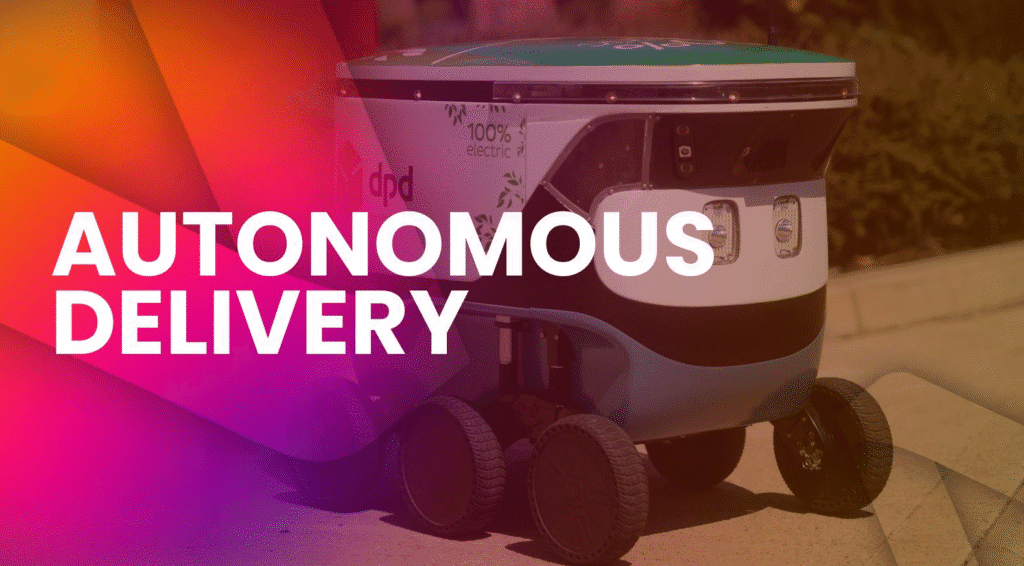
Sidewalk delivery bots are already quietly testing how autonomous vehicles can share pedestrian space in a respectful and predictable way. These compact robots typically move at walking speed, use cameras and lidar sensors to avoid obstacles, and secure parcels behind locked compartments that customers open with mobile codes. From hands on observation of pilot programs, I have found that public acceptance improves when bots move slowly, communicate their intentions with lights, and behave politely at crosswalks and doorways. Their design needs to prioritize approachability as much as technical performance.
Successful integration into daily city life depends on careful route selection and clear operating rules. Delivery bots perform best in neighborhoods with:
- Wide or moderately wide sidewalks
- Relatively smooth pavement and limited steep slopes
- Mixed residential and retail density
- Predictable pedestrian flows
Safety regulations already require bots to yield to people and mobility aids, and many cities cap their operating speeds between 4 and 6 kilometers per hour. These performance limits protect pedestrians but also shape the economic model, since bots function best within a few kilometers of a local hub.
For residents, delivery robots will feel like a new type of street furniture that moves: present enough to notice, but ideally unobtrusive. People will encounter them outside coffee shops, apartment lobbies, and office towers, often during evening or peak delivery hours. Based on my past work with clients exploring robot fleets, customer satisfaction rises when services are highly predictable: fixed delivery windows, accurate real time tracking, and consistent pickup locations within a building. When bots meet these expectations, they start to blend into routine habits rather than feel novel or disruptive.
Core Technologies Behind Autonomous Urban Delivery
The future of autonomous drones and delivery bots relies on a technology stack that combines sensing, mapping, connectivity, and decision making. Both air and ground systems depend heavily on multi sensor fusion, blending camera feeds, lidar or radar, inertial measurement units, and GPS data. This combined input feeds into navigation algorithms that estimate position, detect obstacles, and choose safe paths. In my experience reviewing system architectures, reliability comes less from any single component and more from redundancy and graceful fallback modes.
Artificial intelligence, particularly computer vision and reinforcement learning, plays a critical role in object recognition and adaptive behavior. Drones must distinguish between buildings, trees, cables, and dynamic objects like birds, while delivery bots need to detect curbs, strollers, pets, and sudden changes in terrain. To maintain safety, many systems still pair advanced AI with conservative rule based layers that enforce hard limits on speed, distance from obstacles, and response to uncertain situations. A useful factual note is that most regulators currently require a human supervisor to monitor or intervene for fleets, which means full autonomy at scale is still emerging.
Connectivity underpins fleet coordination and customer experience. Low latency networks, including 4G, 5G, and specialized IoT protocols, transmit command updates, location data, and health checks between vehicles and control centers. Over the long term, cities may invest in dedicated aerial corridors and curbside communication nodes to support reliable urban drone and bot operations. Based on real world testing, robust performance in poor weather, radio interference, and GPS challenged environments requires both onboard autonomy and resilient communication designs.
Rethinking Urban Infrastructure for Autonomous Delivery
As autonomous delivery matures, city infrastructure will need to evolve to support safe, efficient operations. Drones will benefit from designated landing pads on commercial roofs, parking structures, and possibly integrated into new residential developments. These pads can combine charging stations, secure storage lockers, and clear visual markers for navigation. In my experience working with urban designers, incorporating drone ports during new construction is far more cost effective than retrofitting existing buildings after services launch.
On the ground, delivery bots will require:
- Curbside micro hubs for recharging and parcel loading
- Clearly marked robot crossing zones at busy intersections
- Wider, obstruction free sidewalk segments on key logistics corridors
- Secure indoor or semi indoor handoff areas in large buildings
These changes complement broader “complete streets” initiatives that already aim to balance cars, bicycles, pedestrians, and public transit. Importantly, robots should not displace accessibility features. Local accessibility codes remain the primary reference for maintaining clear paths for wheelchairs, strollers, and people with visual impairments.
Urban planners and logistics providers will also experiment with time based access controls. During off peak hours or nighttime windows, fleets of delivery bots might gain priority access to certain curb lanes or shared spaces. Based on city planning workshops I have attended, a phased strategy works best: start with limited zones and timeframes, then expand based on performance data and resident feedback. This step by step approach reduces friction, allows for iterative design, and helps align autonomous delivery with broader smart city goals.
Environmental and Economic Impacts on Cities
Autonomous delivery has the potential to reduce emissions and congestion, but outcomes depend heavily on system design and energy sources. Electric drones and bots powered by renewable electricity can significantly lower tailpipe emissions compared with diesel vans for small parcel deliveries. However, any honest assessment must note that manufacturing vehicles and batteries carries its own environmental footprint, so life cycle analysis is required to claim net benefits. In my experience with sustainability assessments, right sizing vehicles to the parcel load is one of the strongest levers for reducing emissions per delivery.
Economically, autonomous delivery can lower marginal delivery costs, especially for short distance and repetitive routes. Urban warehouses and dark stores positioned near major population clusters will pair with these systems to shorten supply chains. This opens up opportunities for:
- Small retailers to offer same day or even hourly delivery windows
- Restaurants to serve a wider radius with predictable delivery times
- Healthcare providers to distribute medicines and test kits efficiently
At the same time, there are legitimate concerns about labor displacement among couriers and drivers. The most realistic midterm scenario is a gradual transition where human workers take on supervisory, maintenance, and customer facing roles while repetitive routes shift to automated modes. Policy makers and businesses will need to invest in reskilling programs and create pathways for workers to move into higher value logistics and technology positions.
For cities, new revenue models may emerge around curb use fees, low altitude airspace management, and charging infrastructure. Careful design of these frameworks is important to avoid creating barriers for small businesses while still funding the public assets that support safe operations. From hands on work with municipal stakeholders, I have found that transparent fee structures and clear reinvestment plans help build trust among residents and commercial users.
Human Experience, Trust, and Social Acceptance
Technology alone will not determine the future of urban logistics; human perception and social norms are equally important. Residents will judge autonomous delivery by how it feels in daily life: noise levels, visual presence, reliability, and perceived safety. Drones must address legitimate concerns about privacy and acoustic impact, particularly in densely populated areas. Many current designs aim for relatively low noise signatures, but factual testing shows that drones are still audible, especially during takeoff and landing, which must be managed through route and schedule planning.
Trust grows when people understand what the machines are doing and why. Clear visual cues, such as navigation lights and friendly design language, help pedestrians interpret robot behavior. For drones, transparent communication about flight corridors, service hours, and no fly zones can ease anxiety. From hands on projects focused on public engagement, I have found that in person demonstrations and open data dashboards significantly improve acceptance, particularly when residents can see performance metrics like incident rates and delivery accuracy.
Inclusivity must guide deployment. Autonomous services should accommodate residents without smartphones, people with limited mobility, and communities that already experience disproportionate noise or traffic burdens. Practical measures include:
- Alternative access methods such as PIN pads on lockers
- Multi language interfaces and clear visual instructions
- Routing algorithms that avoid sensitive zones like schools during peak hours
By foregrounding human needs and urban equity, cities can ensure that autonomous logistics improves quality of life rather than simply optimizing delivery metrics.
Policy, Governance, and Data Responsibility
Regulation will shape how quickly and how widely autonomous drones and bots operate in urban areas. Aviation authorities oversee low altitude airspace, while city governments manage sidewalks, curbs, and public rights of way. Effective governance requires close coordination between these layers, as well as clear roles for private operators. In my experience participating in policy discussions, pilot programs with explicit goals, data sharing requirements, and sunset clauses are an effective tool for learning before scaling.
Data governance is central to public trust. Autonomous delivery systems collect rich streams of information about movement patterns, building layouts, and customer behaviors. To protect privacy, operators should minimize data collection to what is operationally necessary, apply strong encryption, and limit retention periods. Transparent privacy policies and independent audits help verify that data is not used for unrelated surveillance or targeted advertising. It is a factual requirement in many jurisdictions that personal data handling comply with regulations such as GDPR or similar frameworks.
Ethical frameworks can guide decision making in edge cases, such as how robots prioritize safety when presented with conflicting goals. Clear rules should specify that human safety always overrides delivery commitments or operational efficiency. From hands on collaboration with ethics committees, I have found that mapping specific scenarios, rather than relying on abstract principles alone, leads to better engineered safeguards. As autonomous delivery becomes critical infrastructure, these governance practices will help maintain resilience, accountability, and public legitimacy.
Roadmap to an Autonomous Urban Logistics Ecosystem
Transitioning to a mature autonomous logistics ecosystem will unfold gradually, often in three overlapping phases. The first phase is experimentation, with small scale pilots in defined districts, limited payloads, and strong human oversight. Here, the focus is on learning about technical performance, resident perception, and operational fit with existing logistics. In my experience, these pilots succeed when local communities are involved from the design stage rather than informed only at launch.
The second phase is targeted expansion. Cities approve larger operational areas, and logistics providers integrate drones and bots into mainstream delivery options for selected products. Key capabilities during this stage include:
- Reliable fleet management platforms
- Integration with e‑commerce checkout flows
- Standardized curbside and rooftop interfaces
- Clear incident reporting and review mechanisms
Performance data from these deployments shapes updated regulations and urban design guidelines, reducing uncertainty for future projects.
The third phase is normalization, where autonomous delivery becomes a background utility similar to Wi‑Fi or ride hailing. At this point, city logistics will feel seamless across modes: customers may not even know whether a package arrived via human courier, bot, or drone. Policy priorities will shift from experimentation to resilience, equity, and long term environmental impact. Based on long term technology adoption patterns, the full journey from early pilots to broad normalization can span a decade or more, depending on regulatory agility, public acceptance, and economic incentives.
Conclusion: Building Human Centered Autonomous Delivery Cities
Autonomous drones and delivery bots will not simply speed up shipping; they will reshape how cities move goods, design streets, and serve residents. The challenge is to harness their advantages while preserving safety, privacy, and the human character of urban life.
In the emerging landscape of autonomous urban logistics, success will depend on thoughtful integration rather than raw technological prowess. Drones will complement rather than replace trucks, while sidewalk robots will handle routine short haul tasks that free human couriers for complex, high value interactions. In my experience working with city and logistics stakeholders, the most resilient strategies treat autonomous delivery as one tool among many in a broader sustainable mobility ecosystem.
Stakeholders can follow a practical path forward: start with limited, transparent pilots; co design infrastructure with communities; ensure strong data protection and safety standards; and invest in workforce transitions that create new, higher skill roles in operations, maintenance, and oversight. If cities, companies, and residents collaborate in this way, autonomous delivery can help build cleaner, quieter, and more responsive urban logistics systems that align with long term social and environmental goals.
Frequently Asked Questions
Q1. Are delivery drones actually safe to fly over cities?
Safety depends on strict regulatory oversight, redundant onboard systems, and conservative operating rules. Most current trials use predefined corridors, low flight altitudes, and human monitoring to keep risk within acceptable limits, and regulators typically require incident reporting and certification before expansion.
Q2. Will delivery robots take jobs from human couriers?
Autonomous systems will likely shift some repetitive routes away from human workers, but they also create new roles in supervision, maintenance, fleet management, and customer support. Many logistics providers are planning hybrid models where humans handle complex tasks and high value interactions while robots manage predictable last mile trips.
Q3. How do cities control where drones and bots can operate?
Aviation authorities set rules for low altitude airspace and approve drone corridors, while municipalities regulate sidewalk use, curb access, and pilot zones. Cities can issue permits that define operating hours, speed limits, no go areas, and data sharing requirements to align autonomous delivery with local priorities.
Q4. What happens to deliveries during bad weather?
Most current drone and bot systems have conservative weather thresholds and suspend operations during heavy rain, strong winds, snow, or poor visibility. Logistics platforms usually reroute affected deliveries to traditional vans or reschedule them, and factual safety standards require testing equipment performance across specified environmental conditions before deployment.
Q5. How is my privacy protected when robots and drones are recording their surroundings?
Responsible operators limit video retention, anonymize or blur bystanders when possible, and use encryption to secure data in transit and at rest. Privacy regulations in many regions require that companies collect only necessary data, clearly disclose their practices, and provide mechanisms for users to exercise rights such as access or deletion of personal information.

Louis Mugan is a seasoned technology writer with a talent for turning complicated ideas into clear, practical guidance. He focuses on helping everyday readers stay confident in a world where tech moves fast. His style is approachable, steady, and built on real understanding.
He has spent years writing for platforms like EasyTechLife, where he covers gadgets, software, digital trends, and everyday tech solutions. His articles focus on clarity, real-world usefulness, and helping people understand how technology actually fits into their lives.
Outside of his regular columns, Louis explores emerging tools, reviews products, and experiments with new tech so his readers don’t have to. His steady, friendly approach has made him a reliable voice for anyone trying to keep up with modern technology. get in touch at louismugan@gmail.com